

Treasures in your change – the $1!
Unlike some of Australia’s lower denomination coinage, the $1 coin represents fertile ground for those seeking treasures in their change. Indeed, as you are about to discover, the number of $1 coins you should keep an eye out for is, well, eye-watering! Low-mintage issues, not-issued-for-circulation types, commemoratives, Varieties, Errors…the list of $1 coins worth real money is virtually endless!
What makes a coin rare?
Although it is not a guarantee of rising value, the rarity of a coin can often play a key role in its monetary worth. But what makes a coin rare?
The rarity of a coin, as with items in other collectable fields, is largely determined by the number of existing examples of the coin in question. The ultimate example of a rare coin, therefore, is a coin that is, by definition, unique – there is only one known example. That only a tiny number of a particular coin exist could potentially be attributable to several factors.
Mints strike some coins for archival purposes, or for distribution to government authorities, museums and other mints. Such coins will be struck in the tiniest of numbers – maybe five or ten. Some coins are struck in tiny numbers, but end up being issued for circulation, lost, or withdrawn due to wear and destroyed. Australia’s famed 1930 Penny is a prime example. Other coins are struck in huge numbers, but the entire production run – or a vast majority of it – is melted down and recycled. The 1983 & 1984 20c coins, for example, had sizable mintages, and yet virtually all were melted and shipped overseas as cupro-nickel bars.
Then, of course, you have Error coins, generally known by few examples because of state-of-the-art production techniques and rigorous quality control. The 1981 Scalloped Edge 20c – an Australian 20c coin struck on a metal blank supposed to be used for a Hong Kong $2 coin – is known by less than 10 examples, and is naturally considered very rare. The condition of a coin is also naturally linked to rarity. There may be many examples of a particular coin known to exist, but if there are only a handful in pristine Uncirculated condition, then such a coin would be rare.
The $1 – low mintage mysteries…
The lowest mintage circulating $1 coin is shrouded in mystery. Indeed, most collectors will tell you it doesn’t even exist!
The coin in question is the 1992 Mob of Roos $1, and, according to the Royal Australian Mint (RAM), the mintage is an astonishingly low 8,000. The mere fact that a coin allegedly created for circulation has a mintage so low immediately raises questions – and eyebrows. It is, however, stated in black & white in the RAM’s 1991-92 Annual Report that a 1992 $1 coin was part of the Mint’s ‘Circulating Coin Production’, and that the mintage was 8,000.
It’s possible the entry in the Annual Report is simply wrong, and that no $1 coins were struck. Alternately, it could be that the coins were struck, but subsequently melted down, or perhaps they were not dated 1992. There may be debate about this puzzling coin, but what is certain is that there are no recorded instances of the 1992 Mob of Roos $1 being sighted in circulation. This $1 would be one of the rarest coins around, and would surely be worth thousands if it ever appeared on the market.
Whilst perhaps not quite as mysterious, the 2021 Mob of Roos $1 is another strange case. According to the RAM, the mintage was a mere 160,000! Some believe that this coin was effectively only intended for collector projects, such as the 2021 RAAF Zoom Bags. The 2021 Roos $1 has been sighted in standard RAM coin bags, however, which suggests that a percentage of the mintage was dispatched for use in circulation. Whatever the case, this is definitely one – along with the 1992 Roos $1 – to keep your eye out for!
Other low-mintage superstars!
The 1992 and 2021 issues may be the leading lights, but, when it comes to low mintages, the $1 galaxy is packed with stars! The first $1 ‘obverse commemorative’, the low mintage 2016 Decimal Currency 50th Anniversary $1 is one example.
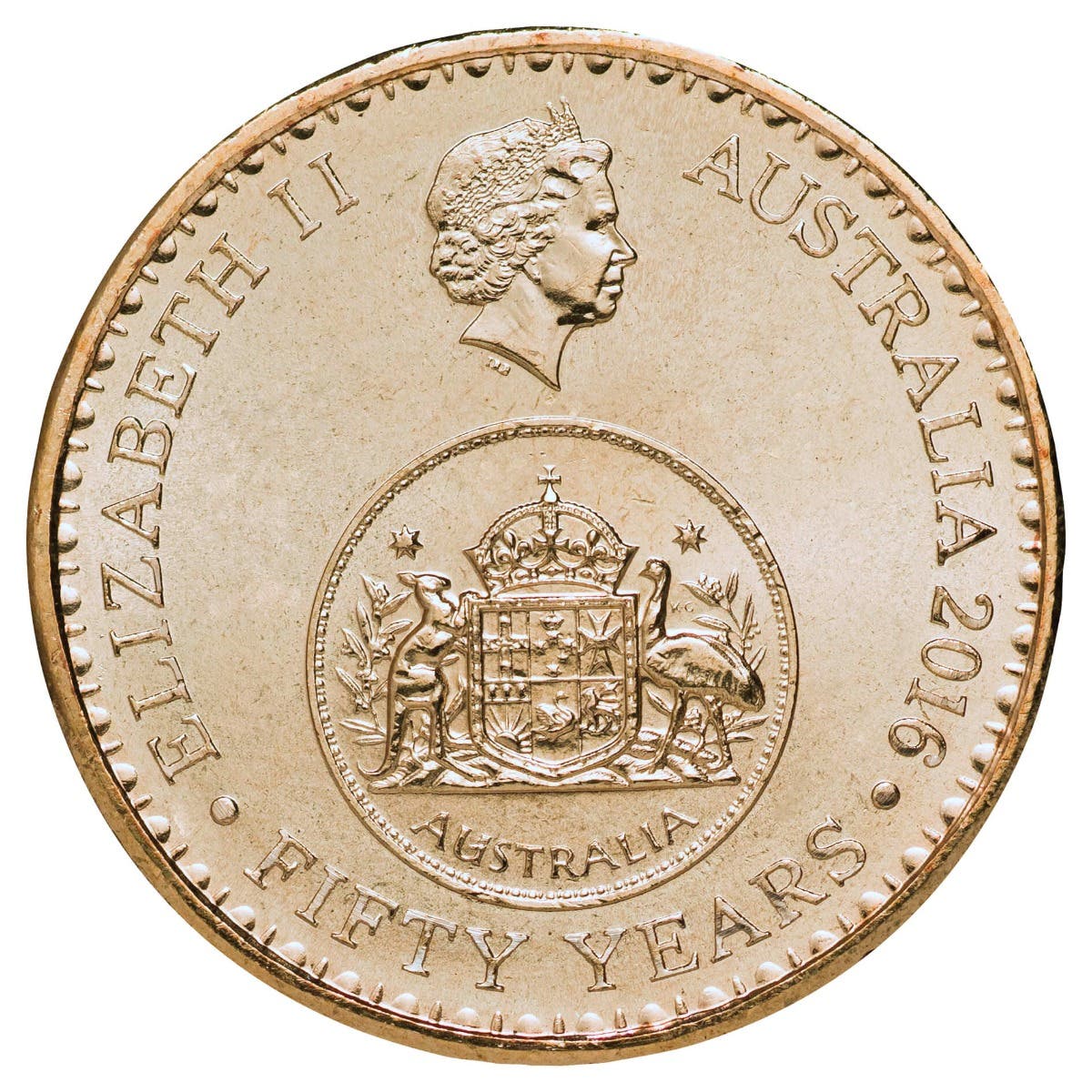
While the mintages of other Decimal Currency 50th Anniversary coins were relatively generous – if not exactly huge – the mintage of the $1 was tiny. It was closed at a mere 560,000 coins! Very, very tough to find in change, and now cataloguing at $30 in Uncirculated condition, the 2016 Decimal Currency 50th Anniversary $1 was, forgetting the mysterious 1992 $1, the lowest mintage $1 issue – briefly, at least!
In 2019, the RAM and Australia Post joined forces to launch the 2019 Great Aussie Coin Hunt. This set comprised a coin for each letter of the alphabet, each coin celebrating an iconic element of Australian life that began with the relevant letter. This was followed by similar sets in 2021 and 2022, and each of the three sets is defined by an extraordinarily low mintage. Released through Australia Post outlets, the 2019 issue had a mintage of 523,000, the 2021 issue had a mintage of 456,000 and the 2022 issue had a mintage of 490,000 – all less than the 2016 Decimal Currency 50th Anniversary $1!
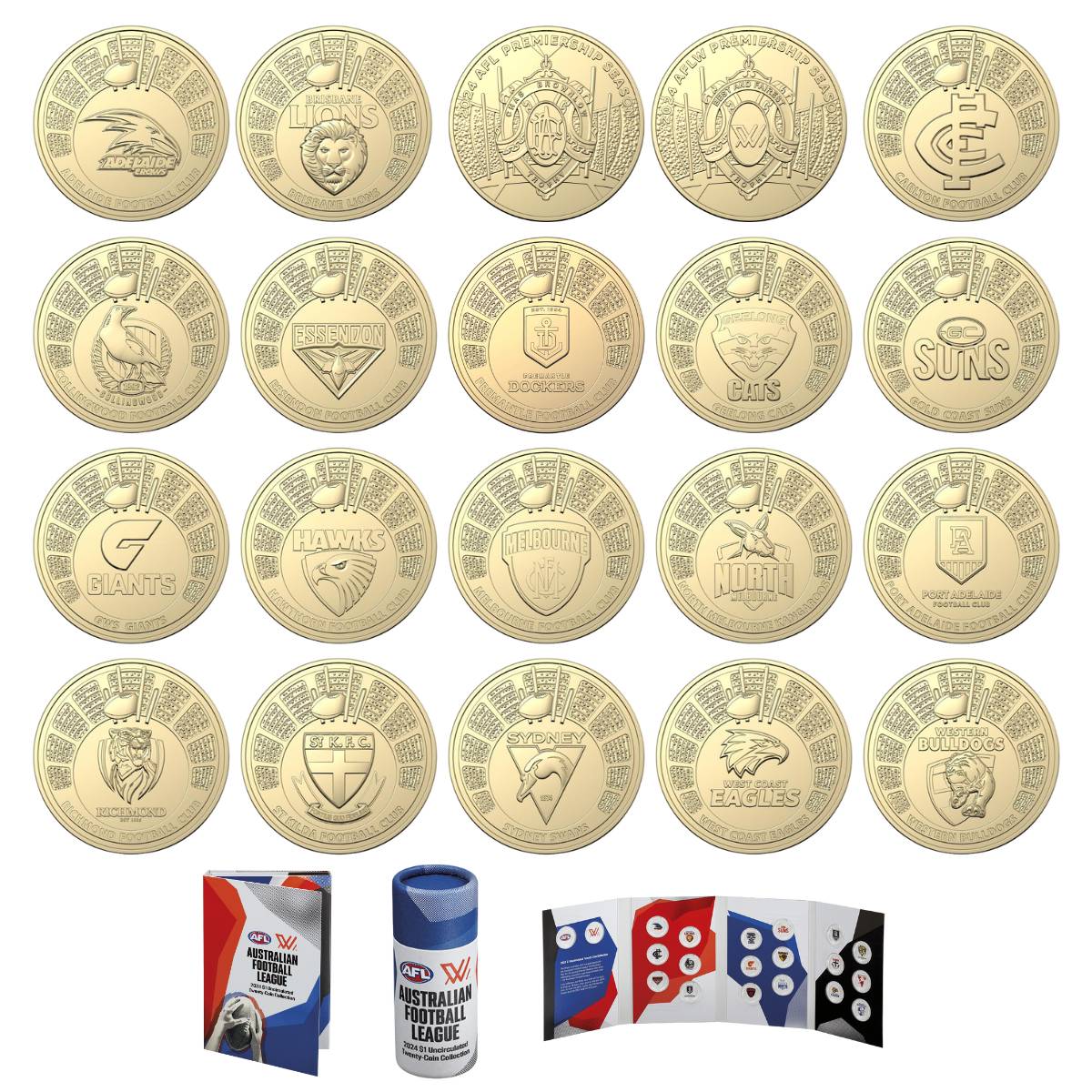
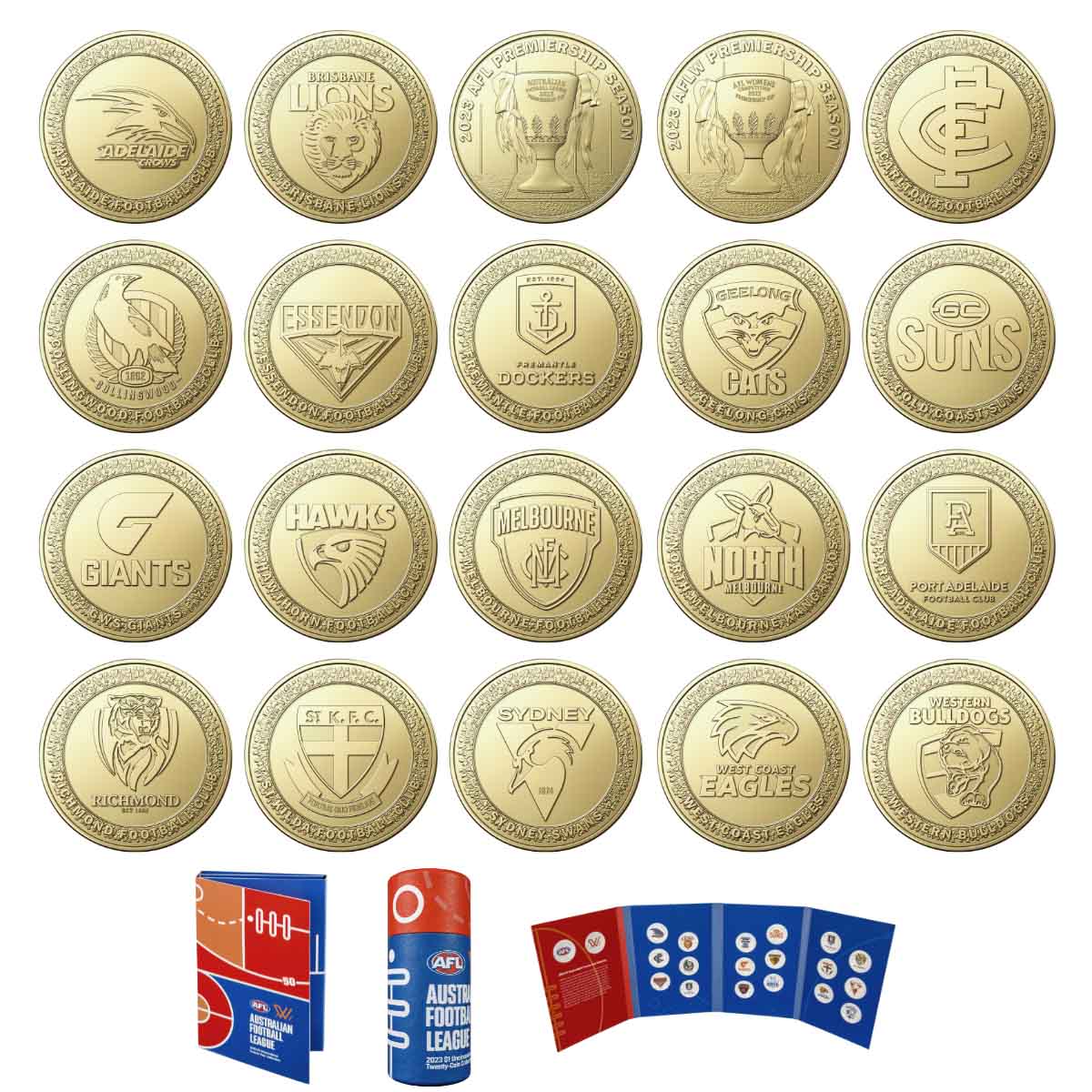
We have subsequently seen similar sets released through Australia Post honouring the AFL (2023 & 2024) and Aussie Big Things (2023). Although the recording of mintages in RAM Annual Reports can be a little tricky, it seems that the 2023 AFL coins have incredibly low mintages. The individual club issues have mintages ranging between 12,000 and 34,000, with the AFL $1 & AFLW $1 having mintages of around 150,000 each. The 2023 Aussie Big Things issues have mintages of around half a million each. Watch this space for more information on the 2024 AFL issues, but, more importantly, watch your change for any of the RAM-Australia Post coins!
More low-mintage marvels!
Among the many low-mintage $1 coins to watch out for, you should definitely keep an eye out the 2014-18 100 Years of ANZAC $1 Series. Four of the five issues have extremely low mintages. The RAM struck a huge number of 100 Years of ANZAC coins in 2014, but only 1.4m in 2015, with the mintages in 2016 (2.19m), 2017 (1.9m) and 2018 (2m) all very low.
With the 2019 A, U & S Privymark $1 coins having mintages of little more than 1.5m, and the 2014 Mob of Roos $1, the 2019 First Clark Portrait $1 and 2020 Qantas $1 having mintages of 1.052m, 2.1m and 2m respectively, there’s good reason to keep your eyes peeled. And not only for low-mintage issues! The 1999 Year of Older Persons $1, for example, has a mintage of 29.3m, and yet has a catalogue value of $20 in Uncirculated quality! And the 2000 Roos $1 has a mintage of 7.6m, and yet catalogues at $50!
Not-issued-for-circulation coins…
Given the nature of inflation, the $1 coin is one of the few Australian coins with some level of spending power, meaning that, unlike, say, the 5c and 10c, it is still used in circulation. The RAM has, naturally enough, struck the $1 for circulation in most years since it was introduced in place of the $1 banknote in May of 1984 – but not in every year. The Mob of Roos $1 was issued for collectors only in 1987, 1989, 1990, 1991, 2007 & 2012. Although not intended for circulation, these dates are found in change occasionally. Although the Renniks Australian Coins & Banknote Values Guide doesn’t list individual values for these not-issued-for-circulation dates, they all trade at well above face value in premium grade.
Beyond the Mob of Roos $1 coins that were not issued for circulation, there is a vast array of RAM commemorative $1 types created specifically for collectors only. Indeed, the $1 commemorative Non Circulating Legal Tender (NCLT) series is the most extensive of any Australian denomination.
One-off commemoratives, Mintmark & Privymark issues, full-colour sets, Lunar New Year issues, Baby Mint Set issues, AFL, NRL, Olympic & Commonwealth Games coins, Woolworths issues and more, there is a huge number of $1 coins that should never turn up in circulation – but they can and do! Even Specimen or Pattern $1 coins – or Specimen/Pattern restrikes – could turn up in your change. You just never know!
With all such rare not-issued-for-circulation Australian coins cataloguing at way over face value in Uncirculated quality, it’s definitely worth checking your change.
Varieties are the Spice of Life!
From our first official mint, the Sydney Mint, through to the Melbourne Mint, Perth Mint and Royal Australian Mint, Australia has a grand history of coin ‘Varieties’ – coins that vary in some way from the standard design for their denominations. Such Varieties may be created by a change in production techniques, or by cracks and other damage to coin dies, or broader issues with the coin press. New Varieties emerge on a regular basis, so, who knows? Maybe you’ll be the one to discover a new type!
Inevitably trading at well over face value, especially in premium grade, here’s some of the $1 Varieties you might find in change…
- 2003 $1 Women's Suffrage Small & Large Reverse types.
- 2001 $1 Centenary of Federation Upset – obverse and reverse not aligned due to obverse die rotating during production!
- 1993 $1 Landcare Cud – small piece on extra metal on reverse.
- 2001 $1 Volunteers Double Cud – TWO extra pieces of metal on rim!
- 2008 $1 Rabbit Ears Roo.
- 2008 $1 Two Tail Roo.
The last four Varieties in that list are caused by the propensity of the Roos $1 die to break, causing ‘cuds’, where a coin is notable for the presence of extra metal on its surface. Other $1 Roo Cud types include the delightfully entitled ‘Spew Roo’, where the top roo looks to have thrown up on the roo immediately below, and the Backpack Roo, where one of the roos looks like it’s setting off for a bushwalk! Sometimes, you see a coin that’s both a Spew Roo and a Backpack Roo! Plenty to look out for!
And Error types…
Due to state-of-the-art equipment and quality control at the RAM, Error coins of any denomination are generally very rare. Mistakes happen, however, and occasionally end up in circulation. Incorrect planchets, blanks, brockages, off-centre errors, double-strikes, double rim errors, upset dies, to name but a few, Error types can be extremely valuable. The more spectacular the Error, the more valuable the coin will be, with some Errors worth thousands – a very good reason to check your change!
Perhaps the most famous RAM blunder as far as the $1 denomination is concerned is the 2000 Roos $1/10c Mule. A very rare event, a Mule is created when the wrong obverse and reverse dies are mistakenly matched. Modern production methods would seem to preclude the possibility of Mules, but in admitting it had struck $1 coins with a 10c obverse die – as illustrated, for example, by the collar around the edge of the obverse – the RAM officially acknowledged the creation of a new and highly desirable decimal type. This coin is worth hundreds of dollars in lower grade, and worth thousands when found in Uncirculated condition.
Sparking great interest among collectors, we have recently seen the emergence of other $1 Mules, including a 2015 $1/10c Mob of Roos Mule (sold at auction in Australia for $2,000), a PCGS-authenticated 2020 $1/10c Mob of Roos Mule, as well as a PCGS-authenticated $1/10c Double Obverse Mule! This shows just how many ‘hidden gems’ could still be out there, waiting to be found by the eagle-eyed collector.
Keep your eyes on your change!
As you can see, even simply from the length of this blog, there are a huge number of ‘Treasures in Change’ emerging from the $1 denomination – and I haven’t even mentioned all of them! The lesson is clear. If you see a $1 coin – any $1 coin – take the time to check it out. Good luck!